Two automation workflows compared: 30 actions processing 1 item costs 30 tasks, while 3 actions processing 200 items costs 600 tasks

What Counts as a Zapier Task? Why a 3-Action Zap Can Cost 20x a 30-Action One

This page contains one affiliate link, marked where it appears. It costs you nothing extra. TL;DR Zapier and Make bill per item processed, not per workflow. Four actions looping over 20 rows is 80 billable units per run, not 4. n8n bills per execution. The same run counts once whether the workflow has 3 nodes or 30, and whether it processes 1 item or 200. This is the whole difference between the models. Zapier does not bill the trigger, failed actions, or most of its built-in tools (Formatter, Paths, Filter, Delay, Looping, Digest, Storage, Tables). Code by Zapier, AI by Zapier and calls to a sub-Zap do use tasks. It is easy to over-count. The fix is almost never a shorter workflow. It is filtering earlier, batching, or moving the fan-out heavy job to per-execution billing. The bill came in higher than the plan you thought you were on, and none of the automations you built last month look big enough to explain it. The one you suspect is probably not the one spending the money. ...

August 23, 2026 · 13 min · G Mohan Jayanth
An automation pipeline with a human review step before anything is sent

How Freelance Writers and Designers Can Automate Client Admin With AI

Disclosure: this page contains one affiliate link, to Make, marked where it appears. If you sign up for a paid Make plan through it, SoloBrief earns a commission at no extra cost to you. Every other link goes to our own free tools, our other articles, or the source behind a claim. TL;DR Automate the admin around your craft, not the craft. Client intake, proposal follow-ups, invoice reminders and turning finished work into social drafts are good candidates. Pricing a job, reading a brief and choosing the creative direction are not. The three main tools bill in different units. Zapier counts tasks, Make counts credits and n8n counts workflow executions, so the same job can cost very different amounts. Cost yours in our free automation cost calculator before you subscribe. Most problems reported on the vendors’ own forums are access and allowance problems: logins that expire, loops that use far more allowance than expected, and free allowances used up during testing. Keep a review step. Have the automation prepare drafts rather than send them, so nothing reaches a client or your feed unread. If you write or design for clients, the work you are paid for is the writing and the design. The work that eats the week is everything around it: chasing a signed proposal, sending the same kickoff questions to every new client, reminding someone that an invoice is overdue, turning a finished piece into posts for your own feed. This guide is about that surrounding admin. ...

August 11, 2026 · 12 min · G Mohan Jayanth
The same workflow billed three ways: 2,000 Zapier tasks, 500 n8n executions, 2,500 Make credits

Zapier vs n8n vs Make Cost Calculator: What One Workflow Bills

Disclosure: this page contains one affiliate link, to Make, and it is labelled where it appears. If you sign up through it we may earn a commission at no extra cost to you. Zapier and n8n are linked only to their own pricing pages, with no affiliate arrangement. The calculator is free, needs no signup, and runs entirely in your browser. TL;DR Each tool counts a different unit. Zapier bills tasks for successful actions, n8n bills one execution per workflow run, and Make bills credits for module operations (Zapier, n8n, Make Help Center). Items processed drive the bill, not the number of steps. On Zapier and Make every action repeats for every item; on n8n one run counts once however many steps or items it has. Six visible steps at 500 runs a month is 2,000 Zapier tasks, 500 n8n executions and 2,500 Make credits, for standard (non-AI) apps and an instant trigger. The worked example below shows the arithmetic. AI steps, code and some connectors cost more than one unit on Zapier and Make. Both vendors say so on their own pages, so the calculator’s numbers are a floor for workflows that use them. This gives you usage, not an invoice. Prices change, and Make’s pricing page loads its prices with JavaScript that our checker cannot read, so this page quotes no Make plan price. The one Make plan figure it uses, 1,000 credits a month on Free, was read on the page by the owner on 12 October 2026, not by script (Make pricing). Zapier, n8n and Make do not bill the same thing, so one workflow produces three different monthly numbers. This calculator applies each vendor’s published billing rule to your workflow and gives you all three. Every rule below links to the vendor page it comes from, read on 9 October 2026. ...

August 9, 2026 · 15 min · G Mohan Jayanth
n8n vs Zapier vs Make automation comparison for freelancers 2026

n8n vs Zapier vs Make for Freelancers 2026: The Billing Model Decides It

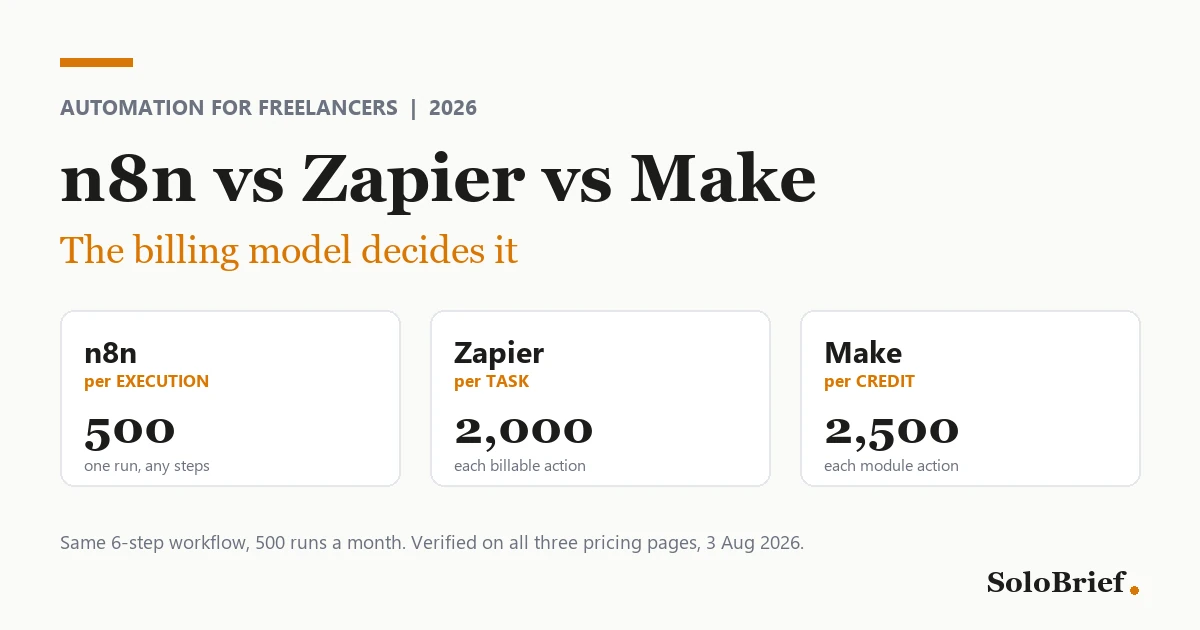
TL;DR The billing unit decides the cost, not the feature list. n8n bills per workflow execution, Zapier per successful action, Make per module action. A 6-step workflow running 500 times a month is 500 n8n executions, 2,000 Zapier tasks and 2,500 Make credits. Pick Zapier if your automations are small and you never want to think about them, Make if you want most of n8n’s power without the setup cost, and n8n if you run high-volume workflows and are comfortable hosting something. Zapier is the easiest to learn; n8n is the cheapest at volume. Pricing verified against all three vendor pages on 3 August 2026. Most people arrive at this comparison holding an invoice. The workflow did not change, the volume did, and the plan that covered January had quietly stopped covering March. ...

August 3, 2026 · 21 min · G Mohan Jayanth