This article contains affiliate links. If you buy through our links, we may earn a commission at no extra cost to you. We only recommend tools we’ve researched thoroughly, and I share my own experience where I have it.
You can launch a professional freelance portfolio website in a weekend: register a domain in your name, set up WordPress on affordable hosting, build five core pages, and make it obvious how to hire you. This guide is the step-by-step path, including the pages that actually win clients and the one cost most people forget to plan for.
I run my own portfolio and client sites on WordPress hosting, so the stack here is the one I use, not a theoretical one.
The short version
- A portfolio site is an asset you own. Marketplace profiles can be suspended or deranked. Your domain cannot.
- Five pages are enough: Home, Work, About, Services, Contact. Build those well before anything else.
- Case studies beat thumbnails. Show the problem, what you did, and the result with a number.
- Plan for the hosting renewal, not just the intro price.
Why does a freelancer need a portfolio website?
A site you own does three things no marketplace profile can. It proves you are a real professional, it shows your best work the way you want it shown, and it lets a client contact you without an algorithm deciding whether they see you. Platforms like Upwork, Fiverr, or Behance can suspend, rank, or change the rules on your profile at any time. Your own domain is the one channel you control end to end.
It is also where you show up in search. When a prospect hears your name from a referral, the first thing many do is search it. A clean portfolio site is what they should find.
Step 1: Decide what the site must do
Before you pick tools, get clear on the job. A freelance portfolio has exactly three jobs:
- Prove you are real and competent (a professional look, your name, your face or brand).
- Show relevant work (case studies aimed at the clients you want).
- Make it easy to hire you (an obvious next step on every page).
Every decision after this serves one of those three jobs. If something does not, cut it.
Step 2: Register a domain in your name
Your domain is your professional address. For most freelancers, your own name (or your studio name) is the right choice: yourname.com if available, otherwise a clean variant. Avoid hyphens, numbers, and trendy extensions that are hard to say out loud.
On most hosting plans, an annual term includes a free domain for the first year, so you can register it at the same time as your hosting. If you already own a domain, you can point it at your new host instead.
Step 3: Choose your platform and hosting
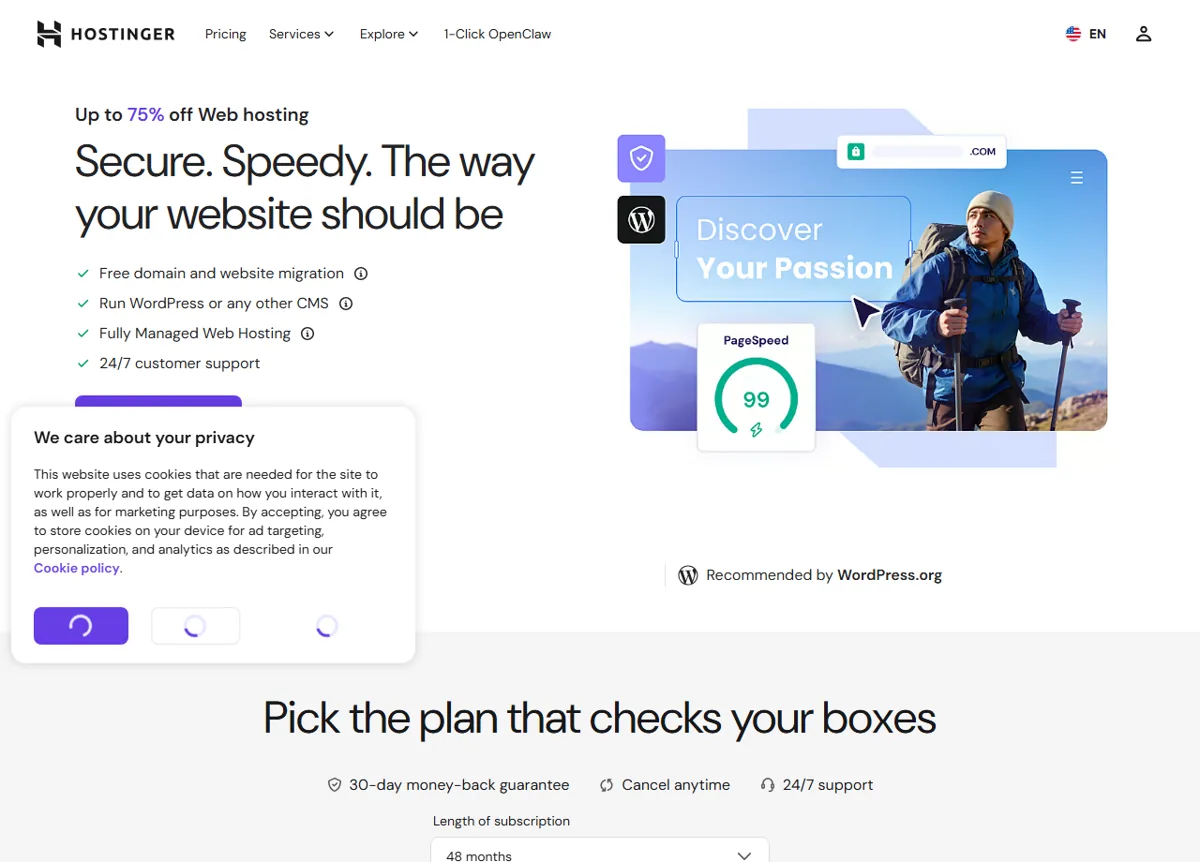 Affordable hosting like Hostinger includes a free first-year domain. Public pricing page, June 2026.
You have two broad paths:
- A hosted website builder (Wix, Squarespace, Framer): fastest to start, but more expensive over time, and your content lives inside their platform.
- WordPress on your own hosting: the most flexible and lowest long-term cost, and what most freelancers grow into. You own the content and can move it anywhere.
For a portfolio you plan to keep and grow, WordPress on affordable hosting is the better long-term call. The setup is no longer intimidating: on Hostinger, hPanel installs WordPress for you in a few clicks. The full walkthrough is here: How to Set Up WordPress on Hostinger.
For choosing a host, the best web hosting for freelancers roundup compares the realistic options, the Hostinger review covers one in depth, and Hostinger vs Bluehost settles the most common head-to-head. One honest planning note: budget hosting advertises a low intro price and renews much higher, so commit to the longest term you are comfortable with and plan for the renewal rate.
Step 4: Build the five pages every freelance portfolio needs
Keep the structure simple. Five pages cover what clients actually look for:
- Home: who you are, who you help, and one clear call to action above the fold.
- Work / Portfolio: your case studies (see Step 5).
- About: the human behind the work, your background, and why you do this. Add a real photo.
- Services: what you offer, in the client’s language, with a clear path to start.
- Contact: the easiest possible way to reach you.
More pages do not make you look more credible. A focused five-page site that loads fast beats a sprawling one that does not.
Step 5: What goes on the work page?
This is the page that wins or loses the client, and the most common mistake is treating it like a gallery. Thumbnails show that you can make things. Case studies show that you solve problems.
For each project, write a short case study with three parts:
- The problem the client had.
- What you did (your specific role and approach).
- The result, ideally with a number: faster turnaround, more signups, more revenue, a launch hit on time.
Three to six strong, relevant case studies convert better than twenty random samples. Pick the work that matches the clients you want next, not just the work you are proudest of.
Step 6: Make it obvious how to hire you
A surprising number of portfolio sites hide the one thing that matters. Fix that:
- Put a clear call to action on every page (book a call, request a quote, email me).
- Make your contact form short. Name, email, and a message field is enough. Every extra field lowers the number of people who finish it.
- Test that the form actually delivers to your inbox before launch. A silent contact form loses every lead.
- Consider a scheduling link so a prospect can book time without back-and-forth email.
Step 7: Cover the SEO and speed basics
You do not need to be an SEO expert, but a few basics help clients find you and keep Google happy:
- Install an SEO plugin to manage your titles, meta descriptions, and sitemap. On WordPress, a free option like Rank Math handles this well.
- Keep the site fast. Use a lightweight theme and a caching plugin. Google’s Core Web Vitals reward speed, and slow sites lose both rankings and impatient visitors.
- Write a services page that targets your specific niche (for example, “freelance email copywriter for SaaS”) so you can rank for the work you actually want.
Step 8: The pre-launch checklist
Before you share the link:
- Your name and what you do are clear within the first screen of the homepage.
- The work page has at least three case studies with results.
- Every page has an obvious next step.
- The contact form delivers to your inbox (test it).
- The site loads over HTTPS and is fast on mobile.
- The site is visible to search engines (not accidentally hidden).
Our recommendation
For most freelancers, WordPress on affordable hosting is the best balance of control, cost, and credibility. It is the setup I use for my own portfolio and client sites. If you want to follow the same path, start with the WordPress on Hostinger walkthrough, and if you are ready to pick a plan you can get started with Hostinger here. Just remember to budget for the renewal rate, not only the intro price.
Frequently asked questions
Do freelancers really need a portfolio website in 2026?
Should a freelance portfolio be on WordPress or a website builder?
How many pages does a freelance portfolio website need?
What should go on the work or portfolio page?
How much does it cost to launch a freelance portfolio website?
How do I get clients to find my portfolio site in Google?
MJ runs SoloBrief.co, a site covering AI tools and software for freelancers and one-person businesses. The hosting recommendations here are based on first-hand use of WordPress on Hostinger. Verify current pricing on any host’s site before buying, since promotional and renewal rates change.