Last updated: 2026-10-13. Next review: 2027-01-13, or sooner if freelancermap, freelance.de or Gotham Ghostwriters publish a new wave.
Pricing AI tools for a freelance business? Start with the automation cost calculator. This page covers who already uses them.
TL;DR
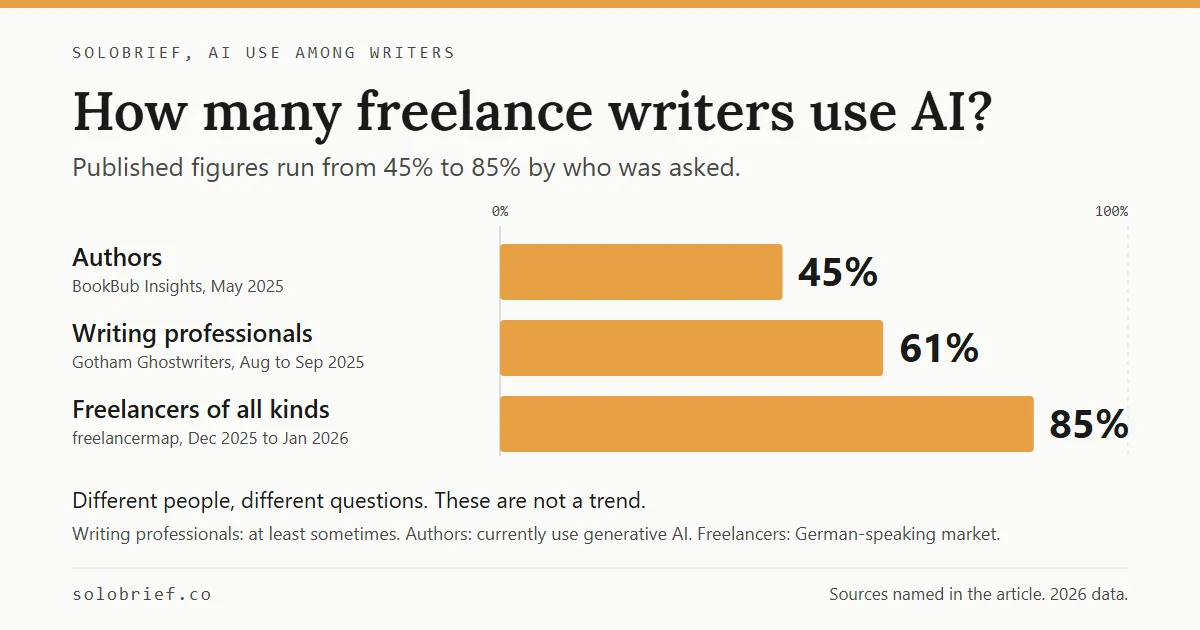
- Published AI-use figures run from 45% of authors (BookBub, May 2025) to 85% of freelancers of all kinds in the German-speaking market (freelancermap, collected December 2025 to January 2026).
- The closest broad match is writing professionals: 61% use AI at least sometimes and 26% daily (Gotham Ghostwriters and Josh Bernoff, 1,190 respondents, collected August and September 2025). A ghostwriting company paid for that survey and it is not a random sample.
- Two surveys of freelance writers alone exist: 70.7% of 2,080 (Elorites Content) and 93% of 157 (Ed Gandia). We read both and left them out of the headline, because the pages print no question wording or exact field dates and Gandia’s respondents came from his own community.
- Among freelancers of all kinds in the German-speaking market, 53% use AI daily (freelance.de, 3,300 freelancers, surveyed January to March 2026). Among writing professionals, 26% do (Gotham Ghostwriters survey). Those are different people, so the two are not a range.
- Earnings data exists, but none of it measures freelance writers directly: 45% of 806 freelance and small-team respondents report reduced demand (Gotham Ghostwriters and Josh Bernoff), and Upwork reports earnings down 28% in AI-based execution tasks (Upwork, first quarter 2026).
How many freelance writers use AI?
There is no single number. The four surveys in the table below put AI use between 45% and 85%, depending on who was asked. Two surveys of freelance writers alone exist as well, and we explain below why they are not the headline.
The closest broad match is a survey of working writers by Gotham Ghostwriters and Josh Bernoff, collected in August and September 2025. In it, 61% of writing professionals said they use AI at least sometimes (Gotham Ghostwriters and Josh Bernoff, 2025). It covers all writing professionals, not freelancers alone, a ghostwriting company paid for it, and it is not a random sample. If you need one figure for writers in general, use that one and label it as writing professionals, with those caveats beside it.
Three figures a writer could quote on their own, each with its source:
61% of writing professionals use AI at least sometimes, and 26% use it daily. Gotham Ghostwriters and Josh Bernoff, 1,190 respondents, collected August and September 2025. Paid for by a ghostwriting company, not a random sample.
45% of 1,229 authors currently use generative AI to assist with their work. BookBub Insights, published May 2025, field dates not stated.
53% of freelancers use AI daily. freelance.de, 3,300 freelancers in all fields, surveyed 27 January to 2 March 2026. Not a sample of writers.
The surveys side by side
Every row below was read on the page that published it. “Data collected” gives the field dates where the source prints them. “What the figure counts” is the source’s own wording for the result, not a question we reconstructed. The link for each row is under Sources and dates.
| Who was asked | Sample | Data collected | What the figure counts, in the source’s words | Result | Source |
|---|---|---|---|---|---|
| Authors, mostly self-published (BookBub partners) | 1,229 authors | Published May 2025, field dates not stated | currently using generative AI to assist with their work | 45% yes; 48% no and no plans to; 7% not yet but might | BookBub Insights, 2025 |
| Writing professionals, fiction authors excluded (sponsored, non-probability) | 1,190 of 1,481 complete responses | August and September 2025 | use AI at least sometimes to aid in their work (question printed in the report: In your work, how often do you use AI tools for writing, editing, or research?) | 61% at least sometimes; 26% daily | Gotham Ghostwriters and Josh Bernoff, 2025 |
| Freelancers of all kinds, German-speaking market (freelancermap) | 1,392 freelancers | 1 December 2025 to 4 January 2026 | nutzen aktiv KI-Tools und Software für Texterstellung, Programmierung und Bildgenerierung (actively use AI tools and software for writing, programming and image generation) | 85% use AI tools; 71% use AI for text | freelancermap Freelancer-Kompass, 2026 |
| Freelancers of all kinds, German-speaking market (freelance.de) | 3,300 freelancers plus platform data | 27 January to 2 March 2026 (press release June 2026) | Laut Studie nutzen 53 Prozent der Freelancer KI täglich (according to the study, 53 percent of freelancers use AI daily) | 53% daily; 23% weekly; 6% never | freelance.de Freelancer-Studie, 2026 |
The two German studies are not about writers. They cover freelancers in every field on two German-language platforms. freelance.de reports that 45% of its respondents work in IT and 7% in marketing; freelancermap does not print the field mix for its AI survey. We include them because they are the largest freelancer samples we found, and because they show how high the figure climbs once “freelancers” stops meaning “writers”.
Why 45%, 61%, 71% and 85% are different numbers
Three things push the figure around: who answered, what counted as use, and which task the question covered. They stack, which is why the spread is wide. This is our reading of the surveys, not a conclusion any of them states.
Start with who answered. BookBub asked authors. Gotham Ghostwriters asked people who write for a living and left fiction authors out of its headline figure. freelancermap and freelance.de asked freelancers in every field. A developer using an AI coding assistant counts toward the 85% (freelancermap, 2026). A survey of novelists has nobody like that in the room.
Then there is what counted as use. BookBub counted authors who are currently using generative AI to assist with their work, and that includes occasional users: 30% of its AI users say they use it occasionally (BookBub, 2025). So BookBub’s 45% is not a stricter test than “at least sometimes”.
The Gotham Ghostwriters report points the same way. It surveyed fiction authors separately, and 42% of them use AI at least sometimes (Gotham Ghostwriters and Josh Bernoff, 2025). That is close to BookBub’s figure for authors. Writing professionals outside fiction scored 61% on the same use-frequency scale. Gotham Ghostwriters’ question also counts research (it asks “In your work, how often do you use AI tools for writing, editing, or research?”), and the report names search as the most popular daily task. BookBub’s wording does not name research.
Our reading is a hypothesis, and neither survey states it: the gap between 45% and 61% comes partly from who was asked and partly from how use was defined, and we cannot split the two.
Last, the task. The nearest thing to a writing number in the German data is that 71% of freelancers use AI for text creation (freelancermap, 2026). The page does not say whether that means 71% of everyone surveyed or 71% of the AI users. Read it as an upper estimate for freelancers who use AI on text. It is not a writer figure.
Using AI is also different from publishing what it writes. Among the writing professionals who use AI at least sometimes, 7% use it to generate text that is then published without significant editing, and 63% use it to generate text that they then edit further (Gotham Ghostwriters and Josh Bernoff, 2025). Both shares are of AI users, not of all writing professionals.
Do freelance writers use AI every day?
Of the four surveys in the table, two report daily use, and they asked very different people.
Among writing professionals, 26% use AI daily (Gotham Ghostwriters and Josh Bernoff, 2025).
Freelancers of all kinds in the German-speaking market report far more: 53% use it daily, another 23% weekly, and 6% not at all (freelance.de, 2026).
freelance.de also reports its own trend. Daily use among its respondents was 19% in its 2024 study and 51% in its 2025 study (freelance.de, 2026). The release does not say the yearly samples are comparable, so read it as a direction, not a measured growth rate.
The chart puts the two daily-use figures side by side. Both report daily use, but the wording is not the same or not printed, and they asked different people, so the two are not a range.
Chart sources: the Gotham Ghostwriters report for writing professionals, and the freelance.de press release for freelancers in the German-speaking market.
Is AI use changing what freelance writers earn?
Two sources we read speak to this. Neither one measures freelance writers’ earnings directly, and they should not be joined into one claim. Studies of job postings on freelance platforms also exist. We did not read them at their source, so they are not used here.
The Gotham Ghostwriters report asked 806 freelancers and small-agency workers how AI changed the value of their work (Gotham Ghostwriters and Josh Bernoff, 2025). Its chart also shows shares reporting no change and an increase. We could not match those figures to their labels in the PDF text, so they are not stated here.
Of those respondents, 45% reported reduced demand and 40% reported reduced income (Josh Bernoff, 2025). The answers are self-reported, and the survey does not show that AI caused the drop.
Upwork’s Future Workforce Index looks at its own marketplace instead of asking anyone. On Upwork, earnings fell 28% in what the report calls AI-based execution tasks, comparing the first quarter of 2026 with the same period a year earlier. Its examples are text, images and video (Upwork Research Institute, 2026). In generative AI and creative production work, per-contract earnings fell 13% while the number of contracts started grew (same report). Neither is a freelance-writer figure, and neither measures AI use. Upwork sorted job posts into categories with a language model, and the report warns that measuring AI work is uncertain and its categories may contain errors. It labels the 28% “earnings” and the 13% “per-contract earnings”, so the two may not measure the same thing. Do not add them or set them side by side.
Do writers tell clients and readers they use AI?
Two kinds of figure exist, and they answer different questions: authors telling readers, and freelancers telling clients.
Among BookBub authors who use generative AI, 74% do not disclose that use to readers (BookBub, 2025). That is authors and readers, so it says nothing direct about client work.
For freelancers and clients, freelance.de’s results blog reports three answers (freelance.de results blog, 2026). 44% of its freelancers do not actively communicate their AI use. 37% have not raised it with clients. 12% disclose it only when clients ask. The blog does not say whether these three answers are exclusive, and they may overlap in meaning (disclosing only when asked is also not actively communicating), so do not add them. Those are German-speaking freelancers of all kinds, not writers.
Ed Gandia’s survey of 157 writers reports that 49.7% have not told clients they use AI (Ed Gandia, 2025). We left that survey out of the headline for the reasons given below.
Deciding where AI fits your own workflow? Our guide to automating client admin with AI covers which tasks are worth handing to a tool at all.
Which number should you quote?
Match the figure to the claim you are making. The source names are linked under Sources and dates.
| If you are writing about | Quote | Say this beside it |
|---|---|---|
| Writing professionals in general | 61% use AI at least sometimes (Gotham Ghostwriters and Josh Bernoff, 2025) | Paid for by a ghostwriting company, not a random sample, fiction authors excluded |
| Authors | 45% currently use generative AI (BookBub, 2025) | Mostly self-published authors, field dates not stated |
| Freelancers of all kinds, German-speaking market | 85% actively use AI tools (freelancermap, 2026) | All fields and all tasks, not writers |
| Daily use | 26% of writing professionals (Gotham Ghostwriters and Josh Bernoff, 2025) or 53% of German-speaking freelancers (freelance.de, 2026) | Different people, so never present the two as a range |
| Freelance writers alone | No figure we recommend as a headline | Two surveys exist (70.7%, Elorites Content, 2025; 93%, Ed Gandia, 2025) but neither prints exact field dates, and the second is small and self-selected. If you cite one, name it and say the dates are not printed |
What these surveys cannot tell you
- How many freelance writers, specifically, use AI, with dated fieldwork and a stated question. Two surveys isolate them, but the pages we read print no question wording or exact field dates, and the Gandia sample is small and self-selected. The Gotham Ghostwriters sample includes freelancers, but the 61% covers all writing professionals.
- Anything a random sample would. None of the four is a probability sample. Gotham Ghostwriters, a ghostwriting company, paid for its survey. BookBub recruited from its own partners. The two German studies come from freelance platforms surveying their own users.
- Who the Gotham Ghostwriters respondents are. Their average age was 51 and their median income was $91,200 across all writing professionals (Gotham Ghostwriters and Josh Bernoff, 2025), so the 61% may not describe writers who are just starting out.
- How much time AI saves. None of them measured hours.
- How much AI is in published text. That is a separate question, studied with detection tools and web crawls, and it does not tell you how many writers use AI.
Looked at and left out
- Elorites Content, State of Freelance Content Writing 2025. A survey of 2,080 freelance content writers in which 70.7% said they use AI-based content writing tools (Elorites Content, 2025). Left out of the headline because the page prints no field dates and no question wording, so we cannot say when the answers were collected or what was asked.
- Ed Gandia, High-Income Business Writing, episode 382. A survey of 157 writers from his own community, in which 93% use AI to some degree (Ed Gandia, 2025). Left out of the headline because the sample is small and self-selected, and the episode page prints no exact field dates or question wording. The survey went out in the month before the episode, which was published on 15 October 2025.
- Medium and Harris Poll, State of Writing 2026. We found Medium’s own post about it, but our checker could not open that page to confirm the wording, so none of its numbers is used. It covers writers in general, so even once confirmed it will not be a freelance-writer figure.
Methodology
We read ten pages at their source and cite all ten. They are BookBub’s survey post, the Gotham Ghostwriters report, Josh Bernoff’s results post, freelancermap’s Zukunft page, its Freelancer-Kompass 2026 PDF, freelance.de’s press release, its results blog, Upwork’s Future Workforce Index, the Elorites Content report and Ed Gandia’s episode page. One more page, Medium’s State of Writing post, could not be opened by our checker, so it is not cited. Every number on this page was checked against a sentence copied from the page that published it.
Data dates are the days each source collected its answers, where it says so. BookBub was published May 2025 with no field dates. The Elorites Content page is dated May 2025, also with no field dates. Gotham Ghostwriters collected August and September 2025. Ed Gandia’s survey date is not printed. His episode page, published 15 October 2025, says only that it went out the month before, so September 2025 is our inference. freelancermap collected 1 December 2025 to 4 January 2026. freelance.de surveyed 27 January to 2 March 2026. Upwork compares the first quarter of 2026 with the same period a year earlier. Last updated 2026-10-13.
Sources and dates
Every number on this page comes from one of these pages. Each entry gives the page, when its data was collected, and the figures taken from it.
BookBub Insights, How Authors Are Thinking About AI: BookBub Insights survey. Published May 2025 (2025), field dates not stated. Figures used: 45% use, 48% no and no plans to, 7% might, 30% of users use it occasionally, 74% of users do not disclose to readers, 1,229 authors.
Gotham Ghostwriters and Josh Bernoff, AI and the Writing Profession: AI and the Writing Profession report. Data collected August and September 2025. Figures used: 61% at least sometimes, 26% daily, 7% of AI users generate text published without significant editing, 63% of AI users generate text they then edit further, 42% of fiction authors, 806 freelancers and small-agency workers, 291 fiction authors, 1,190 writing professionals of 1,481 complete responses, median income $91,200, average age 51.
Josh Bernoff, AI writer survey results: Josh Bernoff survey results post. Published November 2025 about data collected in 2025. Figures used: 45% reduced demand, 40% reduced income.
freelancermap, Freelancer-Kompass 2026, Zukunft: freelancermap Freelancer-Kompass. Survey run 1 December 2025 to 4 January 2026. Figures used: 85% use AI tools, 71% use AI for text, 1,392 freelancers.
freelancermap, Freelancer-Kompass 2026 report: Freelancer-Kompass 2026 PDF. Study design chapter, used only for the Zukunft survey’s field dates, 1 December 2025 to 4 January 2026, and its 1,392 freelancers.
freelance.de, press release on the Freelancer-Studie 2026: freelance.de press release. Surveyed January to March 2026, release dated June 2026. Figures used: 53% daily, 23% weekly, 6% never, 19% daily in the 2024 wave, 51% daily in the 2025 wave, 3,300 freelancers.
freelance.de, Freelancer-Studie 2026 results blog: freelance.de results blog. Survey run 27 January to 2 March 2026. Figures used: 45% work in IT, 7% in marketing, 44% do not actively communicate AI use, 37% have not raised it with clients, 12% disclose only when asked.
Upwork Research Institute, Future Workforce Index 2026: Upwork Future Workforce Index. Platform data for the first quarter of 2026 against the same period a year earlier (2026). Figures used: 28% fall in earnings, 13% fall in per-contract earnings. These describe task categories on one marketplace, not people.
Elorites Content, State of Freelance Content Writing 2025: Elorites Content report. Page dated May 2025 (2025), field dates not stated. Figures used: 70.7% use AI-based writing tools, 2,080 freelance content writers.
Ed Gandia, High-Income Business Writing, episode 382: Ed Gandia episode 382. Episode published 15 October 2025 (2025); the page says the survey went out the month before (September 2025 is our inference). Figures used: 93% use AI to some degree, 49.7% have not told clients, 157 writers.
For a look at one AI tool built specifically around how writers draft, see our Wispr Flow review for freelance writers. If the AI you are weighing is for your calendar rather than your prose, our Motion AI review for freelancers covers that side.
FAQ
What percentage of writers use AI?
Are freelance writers being replaced by AI?
Are all writers using AI now?
Is AI replacing freelancers?